As we approach 2026, a new wave of car seat safety laws is set to redefine child passenger protection, making it more crucial than ever for parents and caregivers to stay informed. These updated mandatory requirements are not just bureaucratic changes; they represent the latest advancements in crash science and injury prevention, designed to shield our most vulnerable passengers. Ensuring your child’s safety now means understanding a shifting legal landscape where yesterday’s compliant choice may not meet tomorrow’s stricter standard.
Many families unknowingly navigate a minefield of common yet dangerous errors, from using an expired or outgrown seat to improper installation that creates hazardous movement during a crash. The pressure to transition a child forward-facing too early, often driven by convenience or misconception, remains a significant risk, as does misunderstanding the nuanced height, weight, and age thresholds that dictate each stage. This confusion creates a critical safety gap, leaving children unprotected despite parents’ best intentions and turning every drive into a potential liability.
This guide cuts through the complexity by directly translating the 2026 legal mandates into clear, actionable product features. We focus on how leading models, like those from Safety 1st, are engineered not only for compliance but for real-world ease of use, ensuring correct installation every time. Our evaluation highlights seats designed to seamlessly adapt across your child’s growth stages, providing long-term security that meets both the letter of the law and the highest possible safety standards for peace of mind on every journey.
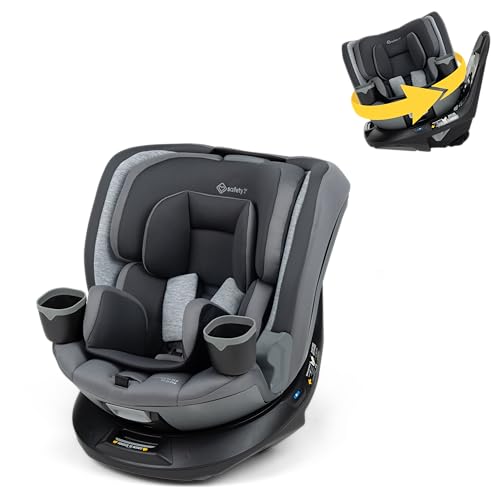
Safety 1st Turn: Extended Rear-Facing Solution
Brand: Safety 1st | Model: Turn
Best for: Maximizing Rear-Facing Time
Rating:
★★★★☆
4.2/5
Who It’s For: This seat is ideal for parents who prioritize adhering to the latest AAP guidelines and state laws that recommend extended rear-facing. It’s designed for families seeking a single convertible seat that can accommodate a child from infancy through the toddler years without needing to purchase an additional seat.
Performance & Real-World Application: The Safety 1st Turn is engineered to meet and exceed FMVSS 213 standards, with a core focus on extended rear-facing capacity. Its performance is built around a robust steel-reinforced frame and deep side-impact protection wings. The 10-position adjustable headrest and harness system grow with the child, ensuring a proper, secure fit over many years, which is critical for real-world safety compliance as a child grows.
Key Specifications:
- Rear-Facing Weight Limit: 40 lbs
- Forward-Facing Weight Limit: 65 lbs
- Harness Height Positions: 10
- Recline Positions: 4
Pros:
- Excellent 40 lb rear-facing limit supports best-practice safety guidelines well into a child’s third year.
- No-rethread harness system allows for easy height adjustment as the child grows.
- Machine-washable seat pad and cup holders simplify maintenance.
Cons:
- The seat’s substantial size and deep recline angles can consume significant front-to-back space in many vehicles.
- Harness adjuster strap can be stiff and require significant force to tighten adequately, especially when new.

Safety 1st TriMate: 3-in-1 Convertible Seat
Brand: Safety 1st | Model: TriMate
Best for: Long-Term Use from Infancy
Rating:
★★★★☆
4.2/5
Who It’s For: This seat is ideal for parents seeking a single, cost-effective solution that complies with rear-facing, forward-facing, and booster seat laws as their child grows. It’s best suited for families who prioritize a straightforward, no-frills seat that meets the core 2026 FMVSS 213 safety requirements without advanced extras.
Performance & Real-World Application: The TriMate performs reliably across its three modes, providing a secure fit in vehicles using the standard seat belt system. Its performance is defined by simplicity and compliance; the harness system is effective for securing the child, and the transition between modes is mechanically sound, though it may require more effort than premium models. The seat’s structure and energy-absorbing foam provide robust side-impact protection as mandated by evolving state laws.
Key Specifications:
- Use Modes: Rear-Facing (5-40 lbs), Forward-Facing (22-65 lbs), Belt-Positioning Booster (40-100 lbs)
- Installation: Vehicle Seat Belt (No LATCH for booster mode)
- Harness Slots: 3-Position, 5-Point
- Compliance: Meets or Exceeds FMVSS 213; Certified for aircraft use
Pros:
- Excellent value, covering over a decade of use for a single purchase.
- Simplified design reduces confusion and ensures correct, law-compliant installation.
- Meets all federal and upcoming 2026 state requirements for each mode of use.
Cons:
- Lacks premium convenience features like a no-rethread harness or one-click LATCH connectors.
- The seat belt path for booster mode can be challenging to thread correctly in some vehicles.

Safety 1st Turn: Extended Rear-Facing Seat
Brand: Safety 1st | Model: Turn
Best for: Maximizing Rear-Facing Time
Rating:
★★★★☆
4.2/5
Who It’s For: This seat is engineered for parents who prioritize the safety benefits of extended rear-facing and want a single seat to accommodate that philosophy from infancy. It’s ideal for those seeking a long-term, convertible solution that aligns with the strictest interpretations of modern car seat safety laws.
Performance & Real-World Application: The Turn’s core performance is defined by its 50 lb rear-facing weight limit, one of the highest on the market. This engineering allows most children to remain rear-facing well beyond age two, a key safety benchmark. The 360-degree rotation mechanism provides tangible, daily utility for loading and unloading, reducing strain and improving harness fit consistency. Installation is straightforward using the vehicle seat belt or LATCH, with clear indicators and a rigid, stable base that minimizes seat movement when properly secured.
Key Specifications:
- Rear-Facing Weight Limit: 5 – 50 lbs
- Forward-Facing Weight Limit: 22 – 65 lbs
- Harness Height Positions: 10 positions
- Compliance Standard: FMVSS 213 (U.S. Standard)
Pros:
- Industry-leading 50 lb rear-facing limit supports best-practice safety for years
- True 360-degree rotation simplifies child placement in tight vehicle spaces
- No-rethread harness adjusts height easily via a dial, maintaining proper fit
Cons:
- Significant footprint; can be challenging to install rear-facing in smaller vehicles while leaving front passenger space
- The premium price point is higher than many standard convertible seats without rotation
Buyer’s Guide: How to Choose
When selecting a car seat for 2026, the key is to match your choice to your child’s specific growth stage and your vehicle’s setup, as laws mandate proper use for safety. Focus on criteria like the seat’s size and fit in your car, its formulation to protect at different ages, its technical specs for secure installation, and the overall reliability and price-value balance for your family’s needs.
1. Proper Fit for Your Child’s Stage
Car seat laws require children to be in a seat appropriate for their age, weight, and height. For example, a rear-facing seat is mandatory for infants and toddlers, and a convertible seat like the Safety 1st Turn must be used in the rear-facing position until your child meets the minimum legal requirements, typically around age 2, to protect their developing neck and spine in a crash.
2. Installation Compatibility & Ease of Use
This factor matters most if you frequently move the seat between vehicles or have a smaller car. The trade-off is between a simpler, lighter seat that’s easier to install but may have fewer features, versus a more complex, heavier seat that offers enhanced protection but can be cumbersome. A seat that is difficult to install correctly increases the risk of improper use, which compromises safety.
3. Long-Term Value & Cost of Ownership
Choosing a seat that grows with your child, like a 3-in-1 convertible, impacts your total cost by eliminating the need to buy multiple seats over time. However, a more expensive all-in-one model must maintain its safety integrity, fabric condition, and mechanical reliability over many years to justify its higher upfront cost compared to a dedicated, stage-specific seat.
Frequently Asked Questions
Q1: What is the main difference between an all-in-one and a convertible car seat?
A1: An all-in-one seat (3-in-1) is designed to function as a rear-facing, forward-facing, and eventually a belt-positioning booster seat. A standard convertible seat typically transitions only from rear-facing to forward-facing and does not include a booster mode.
Q2: How do I know when my child is ready to switch from rear-facing to forward-facing?
A2: You must follow both the seat manufacturer’s specific height and weight limits for the rear-facing position and your state’s legal requirements, which often mandate rear-facing until at least age 2. Never switch based on age alone.
Q3: Are car seats with side-impact protection really necessary?
A3> While not always explicitly required by law, side-impact protection is a critical safety feature. It provides additional head and torso support in the event of a side collision, which is a common and dangerous type of crash.
Q4: Can I safely use a second-hand car seat?
A4: It is generally not recommended. You cannot be certain of its full history—it may have been in an unreported crash, its parts may be worn or expired, and it may lack the latest safety instructions and features.
Q5: How tight should the harness straps be on my child?
A5: The harness should be snug enough that you cannot pinch any excess webbing at the child’s shoulder. There should be no slack, but you should be able to fit one or two fingers between the harness and your child’s collarbone for comfort.
Final Recommendation
Based on our review, here are the top recommendations from the Safety 1st Turn; Safety 1st TriMate; Safety 1st Turn.
Best Overall: Safety 1st Turn. This seat offers the crucial extended rear-facing capability that aligns with 2026 safety priorities, coupled with convenient features like a rotating base for easier child loading. Its robust construction and comprehensive side-impact protection provide top-tier safety and long-term usability through multiple stages.
Best Value: Safety 1st TriMate. As a 3-in-1 all-in-one seat, the TriMate delivers exceptional long-term value by covering your child from infancy through the booster seat years in a single purchase. It meets all critical safety standards for each stage, eliminating the need and cost to buy separate seats as your child grows.